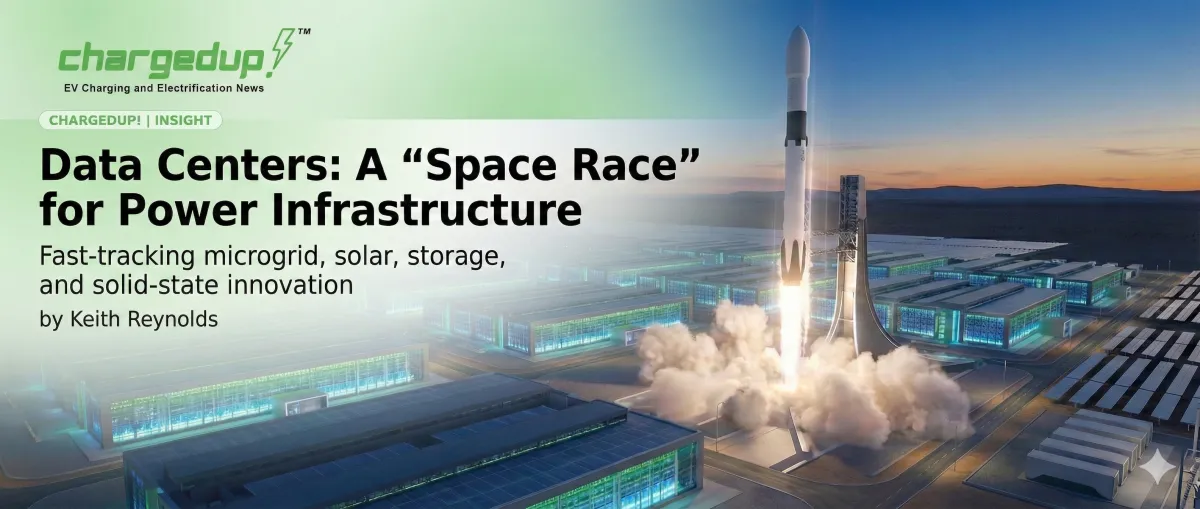
Data Centers: Today's Space Race for Power Infrastructure
By Keith Reynolds | Publisher & Editor, ChargedUp!
Fast-tracking microgrid, solar, storage, and solid-state innovation
If the original space race was about rockets, today’s version is about megawatts. Hyperscale and AI data centers are expanding so quickly that the grid’s normal pace (multi-year transmission upgrades, interconnection queues, and substation rebuilds) often can’t keep up. That timing mismatch is forcing a new energy playbook to treat onsite solar, storage, microgrids, and advanced power electronics as scheduling insurance, not just sustainability add-ons. (Reuters)
The practical result is a surge of investment in behind-the-meter power stacks and a wave of technology that will not stay confined to data centers. Any large-load neighbor that shares feeders, substations, or constrained distribution circuits with a hyperscale cluster (industrial parks, logistics nodes, dense CRE portfolios) will increasingly live downstream of the same innovations and constraints.
It't not just practical. It's existential. For the first time in a century, access to the grid is no longer guaranteed. For the first time, there are real alternatives to the grid. Geopolitically, while China adds power equivalent to Germany’s entire grid each year, the U.S. is stalled—nearly 2,300 gigawatts of projects are stuck in interconnection queues for three to five years. For cities, developers, and landlords, the risk is existential: without guaranteed power, investment goes elsewhere. DG Matrix CEO Haroon Inam breaks it down in a recent interview:
Beyond data center value and AI super-intelligence value, a real gain for society comes from the net-positive economic benefits and quality of life that electrification offers. Even if AI were a bust, there will be many other applications for this next generation of digital power electronics.
The increase of energy options for communities and commercial real estate is exactly where the impact is, and the discussion is moving upward in organizations. Especially, as the subject moves from necessary expenses to capital projects and financial engineering.
Join The Conversation this April 25th - 28th at the APA's National Planning Conference ChargedUp! Pavilion. Call for Speakers, Sponsors & Exibitors.
Why the space-race metaphor fits (and what it changes on the ground)
Data centers don’t just want cheaper electricity. They want power on a construction schedule—with reliability levels closer to critical infrastructure than typical commercial buildings. Reuters has described how long waits for grid connections are pushing data center operators toward on-site generation and storage, noting that some facilities are planned with power requirements exceeding 300 MW. (Reuters)
At the grid-operator level, the urgency is now visible in rule-making and market mechanics. PJM’s approach to fast-tracking large-load connections and near-term reliability measures tends to favor onsite or co-located gas generation because it can meet size/availability requirements more easily than variable renewables alone. (Reuters)
This is where innovation accelerates. When the buyer is massive, time-constrained, and intolerant of failure, suppliers get pulled into rapid iteration of hardware, controls, contracting models, and power architectures.
Innovation #1: “Private wire” solar + storage as a deployment strategy
Solar-plus-storage is emerging as the fastest-to-build power resource that can be deployed near load—especially when paired with “private wire” or “direct connect” configurations that bypass years-long grid upgrade timelines. pv magazine USA describes developers siting solar and battery projects on or adjacent to data center campuses using private-wire approaches to avoid the wait for traditional utility upgrades. (pv magazine USA)
At the same time, industry voices are cautioning that it’s not a simple plug-and-play swap. Hitachi Energy’s CTO told pv magazine that solar-plus-storage for data centers can work reliably, but requires active grid coordination, planning, and the right mix of technologies to remain technically and economically viable. (pv magazine)
Practical application: If you’re developing anything load-heavy near a hyperscale cluster, start modeling co-located generation + storage not as a “nice-to-have,” but as a timeline tool to: (1) bridge capacity early, (2) firm interconnection later, and (3) keep the site’s peak demand within utility limits.
Innovation #2: Microgrids as “quality and schedule insurance,” not just outage insurance
Microgrids used to be sold as resilience. Now they’re increasingly sold as power availability—a way to build and energize big loads while the grid catches up. Reuters’ reporting on microgrids highlights both the rise in deployments and the specific role of “cash-rich tech groups” racing to secure on-site generation and storage for data centers. (Reuters)
For adjacent CRE, the spillover is real: when a data center (or cluster) is the dominant new load, utilities may prioritize upgrades around it, while everyone else faces tighter limits or higher upgrade cost allocations. Microgrid-ready design—space for switchgear, clear one-lines, controllable loads, and a DER roadmap—becomes a real estate competitive advantage, not an engineering preference. Not only can it move projects along faster, but the quality of the current coming into a building is controllable by software. And as Scott Sklar points out when the outcome has a high value the price per gW is relative:
A 50-year veteran of the energy sector, US senate advisor,adjunct professor at The George Washington Universityandfounder of The Stella Group, Ltd, he sees it as the inevitable conclusion of a historical arc that began with the universal service goals of the monopoly-era of electricity and telecommunications in the last century. Haroon Inam calls this the new era of cellular power.
Innovation #3: High-voltage DC and the “power electronics arms race”
AI rack densities are pushing data center power systems to evolve fast. NVIDIA has been openly advocating an 800 VDC architecture as a path toward more efficient, scalable “AI factories,” with a broader ecosystem transition to make storage integration and distribution more practical. (NVIDIA Technical Blog)
In parallel, the Open Compute Project’s “Diablo” specification (from Google, Meta, and Microsoft) describes moving from today’s rack-level DC toward +/-400 VDC or 800 VDC in a disaggregated “sidecar” power rack, enabling much higher-density AI racks. (OCP Blog)
This matters beyond data centers because higher-voltage DC architectures make conversion efficiency, copper use, footprint, and protection systems the new battleground—driving demand for power electronics that can switch, isolate, and route power more like networking gear than traditional transformers.
A concrete example: DG Matrix’s “Power Router”
One of the more interesting “space race” inventions is the attempt to turn site power into something programmable. DG Matrix positions its Power Router platform as a multi-port solid-state transformer (SST) that can combine multiple energy sources and loads simultaneously, with bidirectional ports and grid-forming/grid-following capability. (DG Matrix)
A California Energy Commission filing describes the Power Router as a single compact unit intended to integrate and manage multiple AC and DC sources/loads—grid, solar, wind, batteries, fuel cells, and building loads—highlighting six bi-directional, software-defined ports that can be remotely programmed. (CEC filing PDF) Canary Media described these SSTs as a way to control electricity “as nimbly as routers control the flow of data.” (Canary Media)
“Those that have power will be able to get to AI superhuman intelligence first,” Inam says. “It is very important to businesses and communities, and it is very important to nations.”
Inam’s mantra, "Power is Power," defines the new economic reality for 2026. For the first time in a century, access to the grid is no longer guaranteed. And, for the first time, there are alternatives. (ChargedUp!)
Scaling the Innovation: GE Vernova and ABB
If DG Matrix is the “first-to-ship startup,” GE Vernova is the incumbent industrial scaling story. GE Vernova has confirmed it completed its first solid-state transformer unit and plans to test it through summer 2026 before delivery to a hyperscaler customer. This signals that SSTs are moving from “pilot curiosity” into mainstream procurement roadmaps. (Utility Dive)
ABB has also been explicit about building toward high-density AI data centers using direct-current architectures, pointing to HiPerGuard (solid-state MV UPS) and SACE Infinitus (solid-state circuit breaker) as enabling technologies. (ABB) ABB has also invested in DG Matrix, another signal that incumbents see SST-style platforms as commercial, not experimental. (ABB)
What To Watch: The Three New Pillars of the Power Race
1. The Nuclear "Baseload" Layer
While microgrids solve the timeline gap, the ultimate "Space Race" prize is carbon-free baseload power. Tech giants are increasingly looking at Small Modular Reactors (SMRs) and re-activating dormant nuclear plants. Microsoft’s deal to restart Three Mile Island and Amazon/Google’s investments in X-energy and Kairos Power represent the "Lunar Base" of this metaphor—high-stakes, long-term infrastructure that permanently changes the local grid profile.
2. The Zoning and Spatial Challenge
For the urban planners at the American Planning Association (APA), this isn't just an engineering problem; it’s a land-use problem, its an economic development opportunity. Power-dense sites require massive setbacks, specialized noise mitigation for cooling towers, and "energy-first" master planning. Yet, there are many advantages to regions that offer solid energy delivery a part of their value proposition; including support for these kinds of initiatives. Among many other issues, planners must now balance the economic boom of a data center cluster against the "energy poverty" it might create for traditional residential or light industrial zoning in the same district.
Join The Conversation this April 25th - 28th at the APA's National Planning Conference ChargedUp! Pavilion. Call for Speakers, Sponsors & Exibitors.
3. Virtual Power Plants (VPPs) and the "Good Neighbor" Strategy
Data centers are moving from being power sinks to becoming grid assets. By utilizing their massive onsite battery storage and flexible compute loads, they can participate in Virtual Power Plants. During a heatwave, a data center can offload compute resources to down shift its circuit load or discharge its schedule insurance batteries back into the local community grid, preventing brownouts and making them a strategic partner rather than a resource drain. (Forbes/Dell)
Readiness Check: Here Today vs. Coming Soon
For Corporate Real Estate (CRE) executives, the primary question is: What can I actually spec today? * Here Today: "Private wire" solar-plus-storage, natural-gas-fueled microgrids, and solid-state circuit breakers (like ABB’s SACE Infinitus) are fully commercialized and ready for deployment as "schedule insurance."
• Coming Very Soon (2026-2027): Multi-port solid-state transformers (DG Matrix Power Router; taking orders now and scaling manufacturing in 2026-2027), 800V DC "sidecar" power racks (Schneider Electric), and early-fielding utility-scale SSTs (GE Vernova) are entering the commissioning and delivery phase.
• The Pipe dreams: SMRs and multi-GW "AI Cities" remain long-horizon 2030+ projects. For communities and developers facing a 2027-2028 delivery deadline, the "Here Today" and "Coming Soon" tech stack is no longer an experimental luxury—it is the only way to energize a site when the utility says "no."
Summary: Practical moves for CRE and large-load operators
• Map your electrical neighborhood: Treat substation sharing with a hyperscaler as an opportunity and a market risk factor. Look to neighboring developments where collaboration may bring needed economies of scale.
• Design for controllability: Flexible loads and thermal storage make expansions feasible when the utility says "no."
• Track solid-state routing: SSTs and solid-state breakers are moving from "future tech" to procurement reality. (ABB/NVIDIA, DG Matrix)
Join The Conversation this April 25th - 28th at the APA's National Planning Conference ChargedUp! Pavilion. Call for Speakers, Sponsors & Exibitors.
The punchline: Data centers aren’t just consuming power, they’re reshaping the power product - and fast..
As investors pour money into them and the hyperscalers compete for scarce gigawatts, a new generation of technology is stepping into the fray. There has to be an alignment underway of many other things necessary for changes like this to happen at this scale. As Andrew L. Dunn, Cleantech, Resiliency, and Sustainability Advisor and FENECON Sales Director, pointed out Feb 9 on LinkedIn, "...everything feels like it’s converging at once... across energy, infrastructure, and capital markets."
Competition for energy resources is not just for hyperscalers. Distributed energy is going to show up for many applications. To remain competitive, everyone else has to get smarter with what’s happening in energy, and specifically electrification, right now.
