DG Matrix Raises $60 Million to Scale Solid-State Power for the AI Era
By Keith Reynolds | Publisher & Editor, ChargedUp!
DG Matrix has raised $60 million in Series A funding to accelerate production of its multi-port solid-state transformer platform, positioning the company at the center of a rapidly tightening data center power market. The round was led by Engine Ventures, with participation from ABB, Mitsubishi Heavy Industries and Chevron Technology Ventures, according to reporting by TechCrunch today.
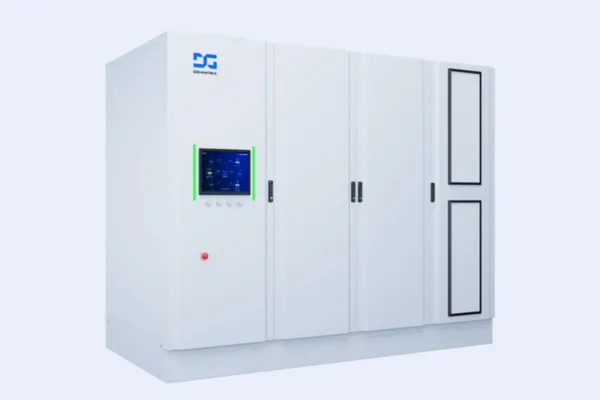
The capital is earmarked to scale manufacturing and deployment of the company’s Interport™ platform, a solid-state transformer architecture designed to manage multiple energy inputs onsite and deliver high-density power loads required by AI-driven data centers.
For property owners and infrastructure developers navigating multi-year interconnection queues and transformer shortages, the development signals a maturation. DG Matrix is no longer presenting a laboratory breakthrough. It is presenting a standardized power architecture for gigawatt-class projects.
From Physics Validation to Production
The first phase of DG Matrix’s story centered on proving that a multi-port solid-state transformer could replace conventional, copper-and-steel transformers with a digitally controlled, software-defined power routing system. That proof-of-concept period is ending.
The Series A will fund production capacity to serve a pipeline of large-scale data center projects. The emphasis has shifted to supply chain, manufacturing scale and deployment velocity.
This matters in a market where grid interconnection delays frequently exceed three years in constrained regions, particularly in parts of the Mid-Atlantic, Texas and Northern Virginia. Data center developers are seeking onsite generation, storage and power electronics stacks that can compress construction schedules and reduce exposure to utility upgrade timelines.
DG Matrix’s solid-state approach enables direct integration of solar, battery storage, generators and grid feeds into a unified power fabric. In practice, that architecture allows high-density loads to be energized faster and with greater operational flexibility.
Interport™: From Component to Platform
Over the past 60 days, the company has shifted its branding and product narrative toward the Interport™ platform, signaling a move from hardware component to integrated system.
Rather than positioning itself as a transformer replacement, DG Matrix is framing Interport™ as a foundational layer that coordinates multi-source power in real time. That shift reflects an operating model closer to a power management platform than a single device.
In recent public statements, CEO Haroon Inam has emphasized commercialization and deployment. When DG Matrix was named to the 2026 Global Cleantech 100 list on January 15th, Inam stated that the company had commercialized a multi-port solid-state transformer to address urgent infrastructure challenges facing AI data centers.
The language has evolved from disruption to integration. Utilities are described as partners in deployment, and the company’s messaging increasingly centers on accelerating capacity additions rather than bypassing legacy systems.
Strategic Delivery Through Partnerships
The most significant maturation signal has come through partnerships.
In early 2026, DG Matrix announced a collaboration with PowerSecure, a subsidiary of Southern Company. The relationship provides nationwide engineering, procurement and construction capabilities, along with established utility relationships.
For developers evaluating counterparty risk, that partnership reduces friction. A startup product now sits within a delivery network backed by a major regulated utility holding company.
In February, DG Matrix also announced a partnership with Exowatt focused on providing dispatchable, gigawatt-scale power for AI facilities. The collaboration aligns DG Matrix with firms targeting high-performance computing and AI factory infrastructure.
The broader market context includes capital commitments to AI infrastructure by firms such as Sam Altman and other technology leaders who have publicly discussed the need for massive new power capacity to support AI workloads.
These partnerships represent more than co-marketing. They embed DG Matrix into national service channels and the AI infrastructure ecosystem.
Institutional Capital as Industrial Signal
The composition of the Series A cap table reflects a strategic shift.
Engine Ventures, an MIT-affiliated venture firm focused on capital-intensive industrial technologies, leads the round. Participation from ABB and Mitsubishi Heavy Industries introduces global industrial balance sheets and manufacturing experience.
Corporate venture investment from Chevron Technology Ventures adds an energy-sector perspective on deployment at scale.
For a company once viewed as a niche hardware innovator, the backing of multinational industrial firms signals institutional validation. It also suggests that incumbent manufacturers see solid-state power routing as complementary to their portfolios.
This form of capital typically arrives when technology risk has narrowed and manufacturing risk becomes the next frontier.
Executive Bench for Commercial Scale
To achieve the internal expansion required for operational scaling, DG Matrix has strengthened its executive bench, including the appointment of Tasha Keadle as chief operating officer and Peter Sopher as chief financial officer.
Inam has stated that the company plans to hire more than 100 technical professionals by the end of 2026. That hiring trajectory reflects a transition from a compact founding team to an industrial organization capable of supporting multi-site deployments.
The visibility of co-founder and CTO Subhashish Bhattacharya in technical briefings and partner demonstrations also underscores a focus on engineering credibility as projects move from pilot to commercial scale.
AI Factories and Power Density
The narrative framing has narrowed in recent months to focus explicitly on AI data centers.
DG Matrix marketing materials released in early February describe data centers as AI factories, emphasizing power density, reliability and load management. The emphasis aligns with industry reporting that AI workloads demand higher rack densities and more stable power delivery than previous cloud generations.
The facility power fabric described in company materials integrates grid supply, onsite solar, battery storage and backup generation through a digitally controlled transformer core. That architecture is intended to reduce deployment friction and improve load balancing under variable demand.
For developers underwriting projects with tight delivery windows and escalating equipment costs, schedule certainty directly influences capital deployment and potential NOI stabilization timelines.
Implications for Real Estate and Infrastructure
The immediate relevance extends beyond hyperscale campuses.
Large-load users sharing feeders and substations with data centers often encounter grid constraints and extended interconnection timelines. Technologies that compress energization schedules can protect construction timetables and tenant commitments.
Onsite power stacks that integrate distributed generation and digital routing offer optionality and cost savings. Developers can phase capacity additions, adjust load profiles and potentially monetize excess capacity under evolving regulatory frameworks.
In constrained markets, transformer lead times and substation upgrades have become gating factors for occupancy. Solid-state transformer platforms designed for modular scaling address that operational bottleneck while providing additional financial benefits.
Commercialization Phase
The $60 million Series A marks an inflection point.
DG Matrix now has institutional capital, industrial partners and a defined high-growth customer segment in AI infrastructure. The Interport™ platform has shifted from proof-of-concept to production focus, and delivery partnerships expand geographic reach.
For infrastructure investors and site planners, the central question is execution. Manufacturing scale, field performance and integration with existing utility frameworks will determine how quickly solid-state architectures move from specialized deployments to mainstream specification.
The broader signal is clear: digital power electronics are entering the capital stack conversation for large-load projects.
