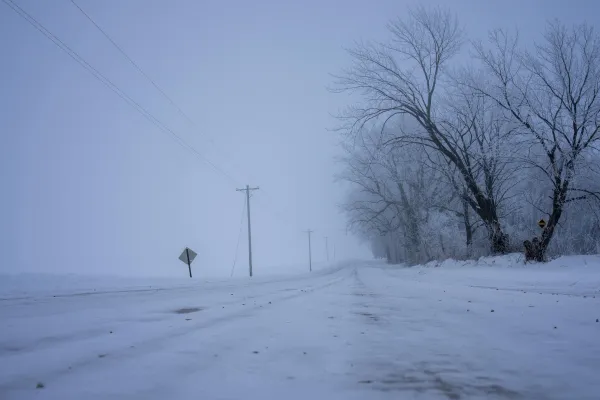
Winter Storm Fern and the new “who provides backup power?” playbook (ERCOT + data centers + emergency authority)
By Keith Reynolds | Publisher & Editor, ChargedUp!
Winter storms used to be a utility problem that spilled into property operations. During Winter Storm Fern, the federal government treated it more like a national reliability event — and explicitly put data centers and other large commercial sites with backup generation on the list of resources that could be tapped to keep the lights on.
On January 24th, the U.S. Department of Energy issued an emergency order (No. 202-26-01) under Section 202(c) of the Federal Power Act that authorized the Electric Reliability Council of Texas (ERCOT) to direct backup generation at data centers — including hyperscale facilities — and other large industrial and commercial sites to operate under specified emergency conditions. The order was in effect January 24th - 27th.
ERCOT’s market notice, which functions as an operational breadcrumb trail for grid participants, summarized the directive plainly: ERCOT could direct those backup resources to run after it deploys market services and before firm load interruption, or during an Energy Emergency Alert Level 3.
Why this matters to CRE (even if you’re nowhere near Texas)
For commercial real estate owners, the story is not data centers getting singled out. The story is that backup power is being treated more like public infrastructure during emergencies, and that has a way of reshaping expectations, tariffs and underwriting across property types.
DOE framed the move as a reliability safeguard. Earlier in the week, Energy Secretary Chris Wright urged grid operators to be prepared to use backup generation at major facilities, saying DOE estimates more than 35 gigawatts of unused backup generation could be available nationwide.
That number is big enough to change how regulators think about the reliability toolkit. The implication for owners is straightforward: the next wave of “resilience economics” won’t be limited to who has a generator. It will increasingly be about who can flex load, who can self-supply for short windows, and who can prove it.
Extreme weather isn’t hypothetical — and the costs aren’t either
ERCOT issued a Weather Watch for January 24th – 27th, citing below-freezing temperatures, potential frozen precipitation and higher demand (while noting grid conditions are expected to be normal during a watch).
The national backdrop is that reliability risk is rising in a way that shows up on spreadsheets. DOE’s storm communications referenced an estimate that power outages cost Americans about $44 billion per year, a figure commonly attributed to Lawrence Berkeley National Laboratory research on sustained interruptions. The NERC’s 2025-2026 Winter Reliability Assessment flagged ERCOT among areas at “elevated risk” under more extreme conditions, where above-normal peak demand and higher generator outages can require operating mitigations.
The emerging playbook: “Who provides backup power?”
The Wall Street Journal described the DOE approach as tapping backup electricity from facilities such as data centers ahead of the storm. Utility Dive similarly reported DOE issued emergency orders across multiple regions, tying them to anticipated peaks and reliability concerns.
For CRE, the most important part is what this normalizes:
1) Resilience becomes a negotiated expectation, not a private preference.
Today it’s a storm-time emergency order. Tomorrow it can become utility programs, tariffs, or permitting expectations that encourage — or require — certain large customers to have defined capabilities: minimum backup duration, load-shedding controls, or storage-ready interconnections.
2) Insurance and lender diligence are likely to get sharper.
Once reliability becomes headline news, the next questions are predictable: Can the building keep operating? For how long? What fails first? What’s the fuel logistics plan? Properties with credible answers tend to underwrite better, especially for uses where downtime is expensive (cold storage, health care, data-heavy tenants, mission-critical logistics).
3) “Backup” shifts from a generator to a portfolio of tools.
Most properties will never be asked to export power. But many will benefit from being able to ride through peaks without buying the most expensive kilowatt. That’s where managed EV charging, smarter HVAC controls, and behind-the-meter batteries become financially relevant — not just as ESG talking points.
A practical lens for owners: what changes Monday morning?
Even if you don’t operate a data center — and even if you’re not in Texas — Fern is a signal that extreme weather is becoming a planning input with real economic consequences.
Start with a simple internal question: if the grid is stressed for four hours, can your property reduce load without wrecking tenant experience? If the answer is “no,” resilience is no longer a philosophical debate; it’s an operating risk.
Fern also reinforces a more optimistic point: the solution set is broader than diesel. In the markets where it pencils, batteries and controls can do double duty — saving money during normal operations and providing continuity during abnormal ones. That’s the direction the resilience conversation is moving: fewer one-off “emergency only” assets, more systems that pay for themselves in the day-to-day.
As this winter has shown, the grid is increasingly willing to treat those capabilities as part of the reliability toolkit, whether the asset sits on a utility balance sheet or inside someone else’s fence line.
